About Hexa Sort 3D
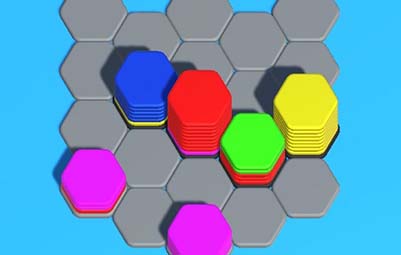
Hexa Sort 3D turns the sort puzzle into a spatial-planning problem where every move ripples across a hexagonal grid. Instead of stacking tubes, you slide and merge colored hexagons into orderly clusters, but the order you touch matters: selecting a tile early can block access to others, forcing a reroute. Each successful merge clears space, but only if you've already scouted which tiles need to pair next. The game doesn't ask you to match colours at random; it asks you to solve a small graph of dependencies, where one misplaced drag can cascade into a dead end. Plan which hexagon you free first, and the rest falls into place.
Hexa Sort 3D is a wonderfully satisfying puzzle game. The core joy comes from sorting and stacking colorful hexagonal tiles into perfect order. It requires smart planning and logical thinking to merge them correctly. As you advance, the challenge grows, creating that perfect, addictive balance between a focused mental workout and a strangely calming flow. Just click or tap to start organizing—it’s a simple mechanic that’s deeply rewarding to master.
How to Play Hexa Sort 3D
- Drag a hexagonal tile onto an adjacent tile of the same color to merge them into a larger hexagon.
- Continue merging same-colored hexagons until all tiles of that color form a single shape and are cleared from the board.
- If you merge the wrong tiles, you may block access to other same-colored tiles—plan your sequence to avoid isolating needed tiles.
- When all tiles on the board are cleared, the puzzle is solved.
Game Features
- 3D hexagonal tiles that stack into larger shapes when merged, adding a visual depth to the sorting mechanic.
- Multiple colors on the board at once, requiring you to manage several merge chains simultaneously.
- Tiles cannot be rotated—only moved laterally, so spacing and adjacency are critical to planning.
- No time limit or moves counter, letting you study the layout and decide the optimal merge order.
- Progressive difficulty introduces more colors and tighter tile arrangements, increasing the need for forward-looking strategy.
Tips & Strategies
- Before making any merge, scan the board for color groups that are already adjacent—they may be safe first moves.
- Avoid merging tiles that are the only link between two isolated same-colored tiles: you might strand one.
- Work from the edges inward: central tiles often block access to multiple colors, so clearing them early opens space.
- If two potential merges compete for the same tile, prioritize the merge that frees up more tiles for future moves.
- Use the remaining tile count per color as a guide: start with clusters that have fewer tiles, as they require fewer steps to clear.
Frequently Asked Questions
What happens if I merge two hexagons of the same color but they aren't the ones I intended to pair?
Once merged, the new hexagon cannot be split. You must work with the resulting shape, possibly blocking access to other same-colored tiles.
Can I move a tile to a non-adjacent space in a single drag?
No, you can only drag a tile to an immediately adjacent empty cell or onto an adjacent same-colored tile to merge. No jumping or teleporting.
Is there a penalty for making a merge that isolates a tile?
No penalty is applied, but the isolated tile cannot be cleared until you free it through other merges, potentially making the puzzle unsolvable.
Do larger merged hexagons count differently from single tiles?
A merged hexagon is treated as a single tile of that color. Merging two of the same size produces the next size up, until the color is cleared.
What happens if I merge the last two tiles of a color?
Merging the final pair clears that color from the board entirely, freeing up space and reducing complexity.
Category & Tags
Game Details
- Category: Color Sort, Object Sort, Shape Sort
- Last updated: March 30, 2026